
Squashed Inside the Great Outdoors
Crossing the Mauritanian desert

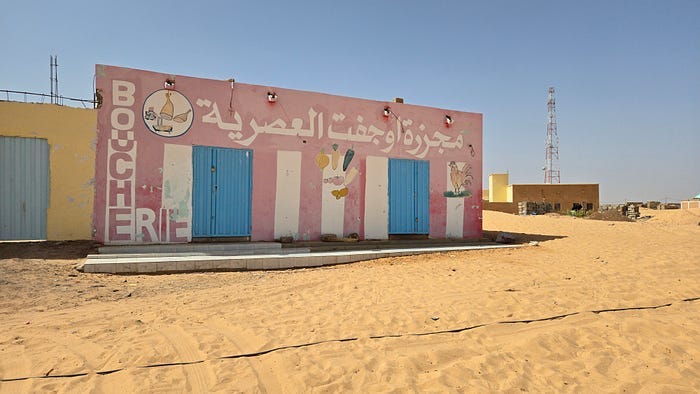
In the rush to get through all the African countries and collect their passport stamps, Mauritania has developed a reputation as a quick, three-day transit along the Atlantic coast for a certain segment of the backpacker community.
For my travel buddy and me, Mauritania was half the reason we went to this corner of West Africa. It certainly occupied half the planning. The country is large and bone-dry, with limited infrastructure. Half of it is painted red on risk assessment maps issued by various Western governments. Getting around involved many unknowns.
We had already reached Ouadane, a town deep in the Sahara Desert, at the literal end of the road. It was time to about-face and return, but I wanted to avoid retracing the long road back to Nouakchott, the country’s capital. The only other way was a track heading south, which is difficult to trace with Google Maps as the satellite photos are hopelessly outdated.
The first stage, an unpaved road from Ouadane to Atar, was easy enough. We hit the washboard at 80 km/hr, the velocity sweet spot to minimize vibration. There were only five of us, including the driver, so we were each given one seat. I knew this luxury would not last.
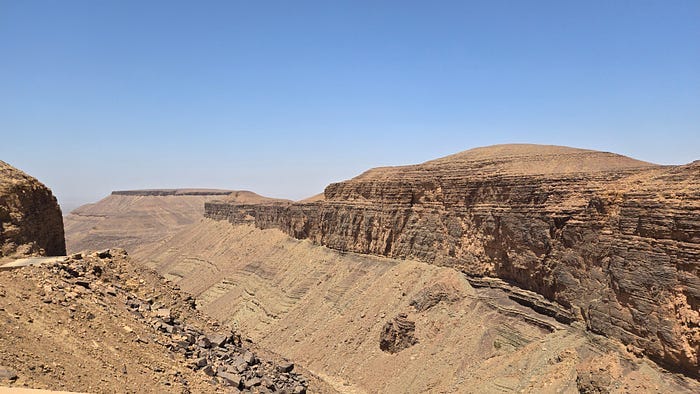
Atar is a big transit hub. I asked several transport companies before finding a truck to take us south to Tidjikja. ‘Tidjikja’ does not run off the tongue easily, so I practiced saying it beforehand to get it right. I wouldn’t want to go the wrong way simply by failing to pronounce the destination intelligibly.
Toyota Land Cruisers are the standard for long-distance transport in Mauritania. They can handle terrain that minivans cannot, which included the route we intended to take. But they have limited cab space, and their shock absorbers are unforgivingly stiff.
Ours to Tidjikja was still loading goods. We kept our backpacks with us, biding our time to see what heavy baggage would be heaped into the bed. There were at least ten bags of concrete mix, followed by sacks of rice, grain, flour, and many boxes of tea. The process looked almost finished, so we handed over our luggage. Everything was tied down with ropes.
Then, along came three people rolling the trunk of a date palm tree. It had roots and some green fronds, so the owner must have intended to plant it. With horror, I watched four people strain as if their lives depended on it to lift it over the side. It landed with a crushing thud on top of everything else, including our packs, and was quickly tied down.
And where were the goats? We never rode transport in Mauritania without them. Sure enough, the last step was to cram two live goats into plastic sacks and place them on the rice and flour.
We were ready to go! Four of us squeezed into the back seat. A Land Cruiser is not designed for this many, so the solution is to angle one shoulder back, essentially imbricating with the other passengers. The front passenger’s seat held a family of three. Two men lay splayed out on the goods and luggage beside the goats. One was the driver’s assistant, who would load and unload cargo. Our driver rounded up a total of ten people.
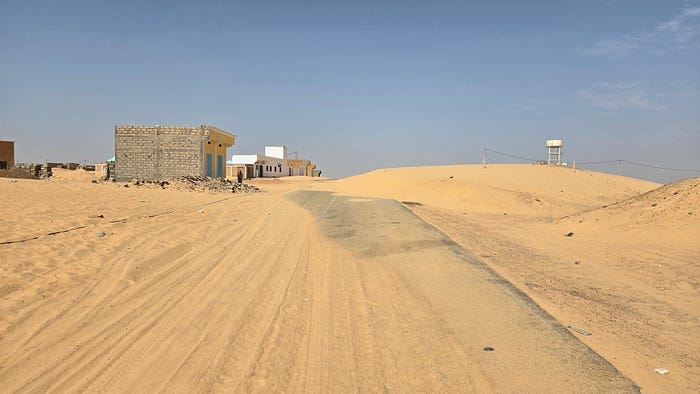
If you look at a satellite image of Mauritania, one striking feature is the lineation of regional dune zones. They sweep across the country like orange tendrils, seeping out of a vast erg that occupies eastern Mauritania, northern Mali, and Algeria. Each tendril contains thousands of separate dunes, inching slowly westward. Our route crossed many.
When dunes move across the landscape, little can be done to stop them. In Mauritania, the solution is to drive over them and keep doing so, even as they advance across the road.
The day drew on and became hot, sandwiched into the back seat. Every fifteen minutes or so, I would have to shift my weight to keep my lower body from going numb. The passenger beside me coughed incessantly, occasionally spitting out the open window.
Yellow bowls of sand alternated with fields of scattered rock, blackened by eons of roasting sun. Villages appeared and disappeared, seemingly abandoned, as many stores were shuttered for Ramadan. There was an occasional jolt as the tires thudded against the lip of a dune, reforming and building in an eternal effort to reclaim the intruding highway. The goat-in-a-sack behind me brayed miserably every five minutes.
We stopped in a few towns. There was no timetable; the driver would park and wander off. This at least allowed us to get out and let our bodies recover for a few minutes.
At one spot, seemingly random, the driver careened off onto a sand track, and we bumped our way out into a collection of grass huts and listless goats. We spent almost an hour here, the assistant unloading boxes and sacks as the driver checked the pile of items against a handwritten list.
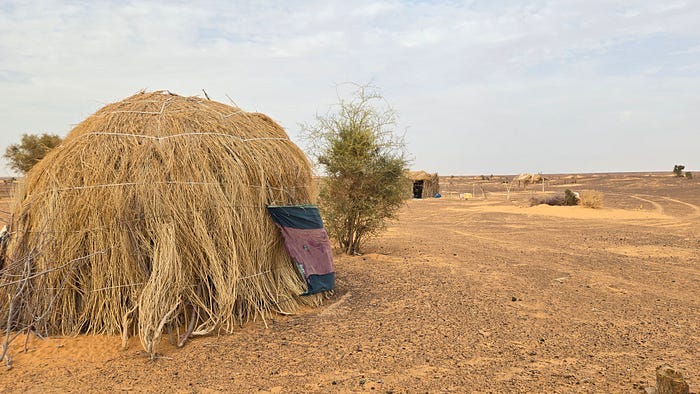
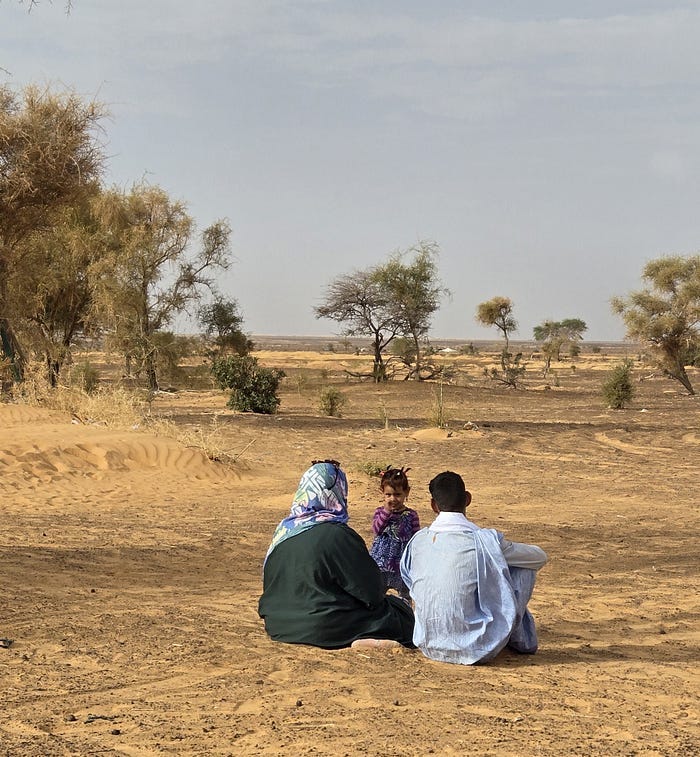
I did not see any grass that would be viable forage for goats. The presence of trees, however, suggested that the water table might be shallow. Perhaps that is why this spot was inhabited. Just the tiniest sliver of livability was enough to make it a settlement.
I watched the sun heading down and worried about how long it would take us to reach our destination. But there was no time out here. Only endurance.
Further down the road, we stopped in a sizable town. Off came the palm tree with a thud. The other passengers wandered off, but the driver and his assistant got back in and started the engine. I decided I wanted to be wherever my backpack was going, so I got back in. We sped off into a wide sandy canyon and another village.
We pulled up to a concrete shed and sat. I didn’t bother asking why we were there because knowing wouldn’t matter. Ten minutes went by, and a woman in black robes appeared. She unlocked the shed, and the driver’s assistant began unloading the bags of concrete mix. Two boys materialized and stored them away. The last rays of the setting sun lit the dunes behind us, setting them on fire with a glowing orange color.
The woman got my attention and smiled, gesturing unmistakably with her fingers and mouth. Let’s go eat. How could I forget that sundown meant the end of Ramadan’s fasting for the day?
She took us all to a nearby tent and rolled out an old blanket to sit on. Inside, I could see huddled figures stooping over bowls. She brought out some plates, filled with dates, the quintessential Ramadan iftar food. I sat there chewing, watching the day’s light fade, listening to the subdued voices of the people around me. I reflected on the tendency to speak softly in the desert, as though muffled by the gravity of the landscape.
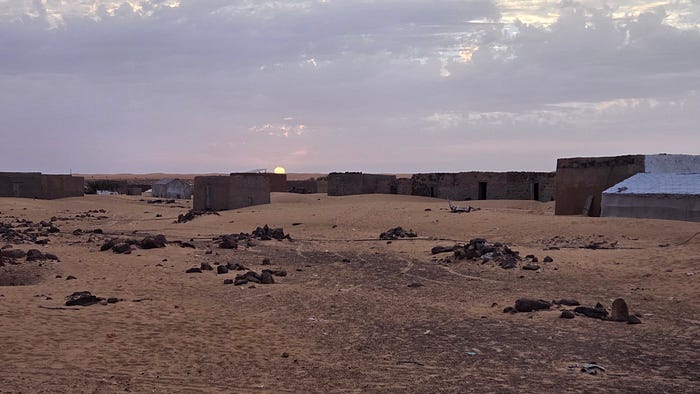
We collected the other passengers in the main village and set out along the dark highway. I try to avoid night travel in Africa, but sometimes, there is no choice. The estimated duration of this trip had already passed, and we were nowhere near Tidjikja.
The roadside was just murky shadows. I did not know what banditry might exist this far out in the Sahara. We passed a man walking a camel along the road, going from one empty valley to another. A bare light bulb in the distance silhouetted a mosque, so far away from anything that I wondered who would go all that way to pray.
We passed large sacks of charcoal piled on the asphalt. An unseen figure shouted from the darkness, and the driver slammed on his brakes. Three voluminous women in dark robes emerged and entered into a protracted conversation with him. Ten minutes passed before money was exchanged, and the sacks were loaded into the truck. The women went in last, lifting each other with great effort and drama to sit with their merchandise. Tradition forbade the men in our group from helping, as that would involve touching them.
The most memorable moment of the evening was crossing a rise onto a flat plain of dunes. I caught the unmistakable whiff of rain, though there was no hint of moisture where we were. Far off to the west, a silent flash of lightning suddenly illuminated the landscape, tinting the dunes a faint hue of purple. Several passengers gasped. For that instant, we were all captured by the same still image of beauty.
In Rachid, we were detained by an annoying soldier at the town checkpoint, who spent far too long mulling over everyone’s identification papers in hopes of coaxing out a few ouguiya in bribes. Then, the rotund charcoal merchants left with their bulging, dirty sacks, grunting and complaining their way down from the pickup bed. People passing down the dark street, humored by the scene, stopped to watch the entertainment.
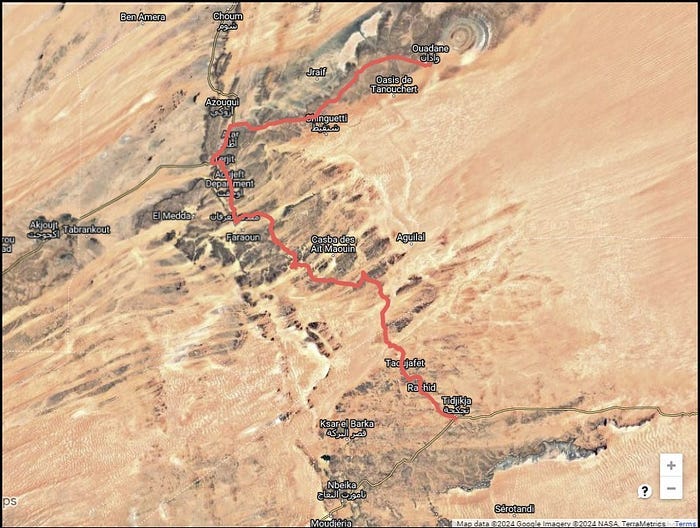
The road surface improved after Rachid, and the rest of the trip flew by. We arrived in Tidjikja a hair before midnight. My phone mapper was now operative, and I had marked the coordinates of where to stop. I pointed out an open storefront to the driver, and with a huge relief, we disembarked. My legs and ass rejoiced that today’s transport was over.
The store was open because everyone stays up late during Ramadan. As we stood on the street, two young men, faces alight with devious joy, raced by on horses bedecked with metal beads that jingled musically. Down the dark street, they wheeled around and tore by a second time, whooping to get as much attention as possible. It reminded me of US teenagers trolling the main drag of a small town and racing their engines on Saturday night.
I asked the name of a hotel I had read was nearby, and the store owner sent her son with us down the street to bang on a plain gate with no sign. A man stepped out of his house, tossed the trailing corner of his robe over his shoulder, and let us in. The room he gave us was dusty and missing a fan, but it was somewhere to sleep and had running water.
Long after I’ve forgotten being crushed into a hot pickup, sustaining endless muscle pain, and feeling the disquiet of ambiguous fears, I will remember these Saharan scenes, odd and beautiful things I will never see exactly the same way again. For these unforgettable travel moments, having no space to move in the boundless outdoors is worth the irony.
I was captivated until the end and wanted to read more. 🌻
Great writing Brad. Really evocative and compelling. I havent been to that part of the world and I feel it scares me - not so much the threat of war or violence per se (thats usually an over blown fear) but the constant discomfort and uncertainty. It seems almost a zen exercise being there as much as a travel experience. You are hardier than me my friend, altho I probably would have been up for that kind of action when I was younger! When were you there and would you go back?